


An O-1A or EB-1A petition can run to hundreds of pages. Behind those pages is usually much more than a collection of documents. A career. Years of work. Professional achievements that took a decade to accumulate. And often a decision about what comes next: where someone builds a company, sets up a family, leads a team, or continues their research.
That is why a strong immigration case cannot be treated as a document that someone just assembles at the end of the process.
It is a project that has to be planned and coordinated around the person behind it. Identifying which criteria a profile can actually carry. Requesting confirmation letters early enough that busy people can write them well. Collecting metrics with their sources attached. Making sure dates and titles agree across dozens of exhibits. Staying reachable if USCIS comes back with questions.
None of this is difficult in isolation. It becomes difficult when nobody owns it. That is what case management is for.
What case management actually means
A managed case has one shared view of the timeline, the evidence, and the decisions behind it.
That view has to hold the schedule, an evidence map tying claims to documents, current document versions, USCIS forms and deadlines. It also includes expert letters, translations, status records such as I-94s and prior approval notices, and an exhibit index that matches the record.
The decisions matter as much as the documents. When USCIS asks for more evidence after filing, the difference between deliberately excluded and simply overlooked changes is how you respond. If nobody wrote it down, nobody remembers.
Legal strategy, the petition narrative, and representation before USCIS require a licensed attorney. The timeline, evidence map, version control, and follow-up with recommenders are project work. These are different responsibilities.
Structure matters because USCIS reads the whole file
USCIS reads an O-1A or EB-1A petition in two passes, and the two stages ask different questions. For the O-1A, the initial regulatory threshold requires either a major internationally recognized award or evidence satisfying at least three of eight criteria. EB-1A similarly requires a one-time achievement or at least three of ten.
Meeting the required criteria does not by itself establish extraordinary ability. USCIS then looks at the record as a whole and considers whether the evidence, taken together, supports the case. That second stage is why it matters how the evidence fits together. For a closer look at this second stage in EB-1A cases, see: How the EB-1A final merits determination works.
Coherence has to be built, not retrofitted. A CV, a recommendation letter, and a funding announcement can each be accurate and still give three different versions of a start date or a job title. Nothing there is false. But a record that contradicts itself is harder to approve. Cross-reading documents against each other is cheap in week two and expensive in week eight, which is why it belongs at the start of the schedule rather than the end of it.
The strongest evidence is not the most evidence. The goal is not to claim every criterion within reach or file every document available. A criterion argued on thin documentation does not add weight. It can invite scrutiny.
A petition that is read twice has to work twice. That is what makes O-1A and EB-1A cases a management challenge, not just a drafting exercise.
What the process actually looks like week by week
In our experience, an O-1A or EB-1A reaches filing readiness in roughly six to eight weeks from the first evaluation.
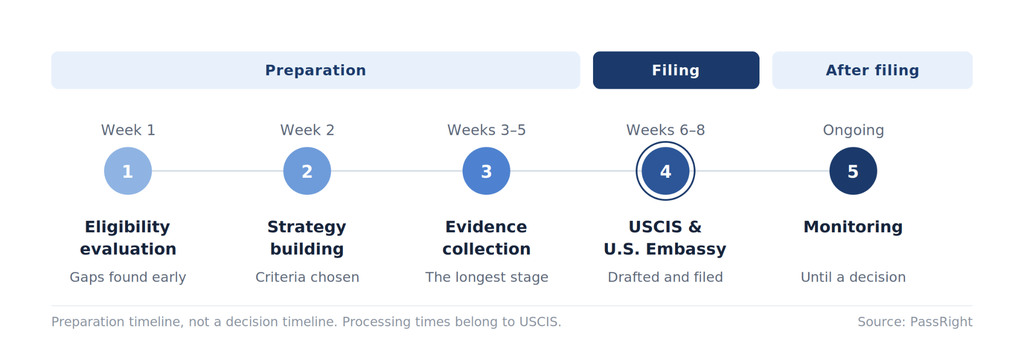
Week 1: Eligibility Evaluation. Your professional profile is reviewed against the criteria that may support the case, with gaps identified while there is still time to address them.
Week 2: Strategy Building. Your attorney builds the legal strategy: which criteria to argue, which to drop, and what evidence is needed to support the case.
Weeks 3–5: Evidence Collection. Evidence is collected and mapped to the relevant criteria, with gaps identified and addressed as the record takes shape. Letters, metrics, media, translations, and other records are gathered in parallel rather than one after another. This is typically the longest stage and demands real discipline.
Weeks 6–8: USCIS & U.S. Embassy. The petition is drafted, reviewed, assembled, and filed. Each claim in the petition letter is tied to a specific exhibit, and a separate read checks for conflicting dates, titles, and numbers before anything is submitted.
After filing: Monitoring. Once the petition is filed, the case enters USCIS adjudication. USCIS may approve the petition, issue a Request for Evidence (RFE) or a Notice of Intent to Deny (NOID), or deny the petition without first issuing either, depending on its current guidance on evidence and RFEs.The legal team remains involved through adjudication and, where applicable, the U.S. Embassy process until relocation is finalized.
The drafting is rarely the bottleneck. Once documents are in hand, a petition can typically be prepared in about two weeks. The schedule is set largely by how fast evidence arrives, which means the applicant, not the drafter, controls most of it.
This is a preparation timeline, not a decision timeline. Reaching filing readiness in six to eight weeks says nothing about how long USCIS will take to decide the case. Processing times vary with the case and USCIS workload. Premium processing can speed up USCIS action, but it does not guarantee approval.
This is also why it helps to start before anything becomes urgent. Some cases begin because something has already become pressing: a fundraising round that requires U.S. presence, a key hire who needs a manager on the ground, a planned launch, or travel that cannot move. Those cases get built under constraints that have nothing to do with the strength of the profile. Working backwards gives you more options. For example, if a raise is planned for Q3, filing readiness may need to be in place by Q1, with evidence collection starting in the preceding quarter. The evidence itself does not improve when the calendar tightens. Only the options do.
TIP: Do not wait until the week of filing to collect expert letters. Recommenders are busy people, and a strong letter typically takes three to four weeks to come back signed. That is why they can become one of the biggest bottlenecks in the timeline. Start the request early, with a clear draft, a specific project or result the recommender can speak to, and a deadline.
But do not finalize the letter too early. If the evidence around it changes, a letter finalized before the record is settled can end up describing the project differently from the exhibits. Start early, but leave enough time to make sure the final letter matches the evidence.
A late letter rarely means one late document. The recommender goes quiet, someone has to follow up, the draft waits, and the quality check can slide into filing week.
Where filing-only approaches break down
Missing context. A document appears with no explanation of why it matters. The officer is left to infer the connection.
Inconsistent details. A role that reads “Head of Engineering” in one exhibit and “Engineering Lead” in the next. Small on its own, but it creates a question the rest of the record now has to answer.
Weak letters. Requested too late, from whoever was available, without enough context for the recommender to address the specific work that matters to the case.
Duplicated documents. The same article filed three times under three criteria. It thickens the package without adding weight, and on the whole-record read it looks like padding.
Wrong criteria. Weeks spent building evidence for a criterion the profile was never likely to support, only to drop it later.
No room to respond slowly. If USCIS requests additional evidence or issues a Notice of Intent to Deny, the response deadline is limited and must be met. Missing the deadline can result in denial. These are not isolated problems. One delay or oversight can create another, and by the time it is noticed, there may be little room left to fix it.
Filed only vs. case managed: what changes
| Filed only | Case managed | |
| Evidence | Collected near the deadline | Mapped to criteria in week one |
| Consistency | Left to chance | Dates, titles, and facts checked across the record |
| Letters | Whoever replies in time | Chosen for relevance, approached early enough to revise |
| Timeline | Discovered by reading old email threads | One shared schedule everyone works from |
| If USCIS requests more evidence | Rebuild the file from scratch | Answer from evidence already indexed during the build |
The last week before filing should be boring. When it isn’t, something upstream wasn’t managed.
Case management cannot prevent an RFE. That judgment belongs to the officer. What it can do is close the gaps that were closable: the unexplained exhibit, the contradictory detail, the claim with no source. A record built to answer predictable questions tends to draw fewer avoidable ones, and it is far faster to defend when a question does come.
What you can control
Most of the timeline runs through you. A few habits make a disproportionate difference:
- Keep records as you go. Contracts, offer letters, award notices, press mentions, speaking invitations.
- Save your metrics with sources. Revenue, users, citations, downloads, funds raised, and where each number came from.
- Label documents so they can be found. 2024-05_TechCrunch_feature.pdf beats scan_final_v3.pdf every time.
- Update your CV first, not last. A CV revised after the rest of the evidence is gathered is the single most common source of contradictions in a file.
- Get translations certified. Anything not in English needs a certified English translation, so the evidence can be read without ambiguity.
- Check dates and titles against the CV before anything enters the exhibit list.
- Answer promptly. More often than people expect, the entire case is waiting on one reply.
None of this requires legal expertise. It requires doing it early, which is the part that is genuinely hard when you are also running a company.
The strongest file is the one that is easiest to understand
The strongest file is not necessarily the largest one. It is the one where the strategy, evidence, supporting letters, and narrative fit together clearly enough that USCIS does not have to reconstruct your career from dozens of exhibits.
A strong case is built long before filing day, through the choices made about criteria, evidence, letters, and the record as a whole.
One question comes up more often than any other: can AI do this? It can help organize information and documents, but it cannot build the strategy for your case, decide which evidence matters, or turn your career into a clear and credible story. That requires human judgment and an attorney who understands both the law and the experience behind your case. Where AI helps and where it doesn’t →
If you are considering an O-1A or EB-1A case, the first step is understanding not only whether your profile may qualify, but what evidence, timing, and coordination the case will actually require.
Need help with your case? Schedule a call with our customer care team. They’ll be happy to discuss your needs and connect you with an immigration attorney.


