


Analysis & visualization: PassRight
A strong immigration case is more than just a stack of documents
Analysis & visualization: PassRight
A strong immigration case requires credible, verifiable evidence deliberately and directly connected to the correct USCIS criteria. Strong cases explain each piece of evidence and its connection to the criterion, allowing the officer to clearly see why the applicant stands out as extraordinary without having to guess.
A strong and clearly laid out case is not about volume. USCIS explicitly warns that “voluminous documentation may not contain sufficient persuasive evidence” of eligibility. This means that a bloated 400-page filing can readily lose to a 90-page filing; the evidence, documentation, and how they are organized and expressed within the filing is what determines a strong filing.
Do: document and structure a filing; do not: document dump.
Verifiable and specific evidence
A strong case “shows” as much, if not more than, it “tells” the officer why the beneficiary is extraordinary. This means that every single claim requires evidence: objective metrics, screenshots, articles, and information the officer can verify the claim against. It is insufficient to merely “tell” the officer that the beneficiary was in a critical leading role at a distinguished company, for example; the filing must also “show” concrete evidence of that role and of the company’s distinguished reputation with metrics, screenshots, confirmation letters from seniors at the company, media coverage of the company, etc.
Persuasive evidence is as specific as possible, including names, dates, and other concrete figures. Evidence is “verifiable” when the source is external and objective, meaning the source is independent of you.
A claim like “our product grew quickly” is a mere “tell” without a “show,” which makes it unverifiable. Pair this claim with a discussion of a board deck showing, for example, 120,000 monthly active users and $4.2 million in annual recurring revenue, plus a CFO letter confirming those figures, all of which are contextualized in confirmation letters and included in the exhibits list: the “show”/“tell” of the claim is balanced, and the evidence is sufficiently specific and verifiable.
| Weak evidence | Stronger evidence |
| Undated screenshot of a website mentioning you or your work | A bylined article in a named outlet, including the title, date, and author, and other verifiable details |
| Letter calling you “world-class” | Letter naming the system you designed, where it runs, and what it changed |
| A certificate with no context entered as evidence of an award | Award rules showing the applicant pool, judges, selection rate, and criteria for selection |
“Show” is > “tell”: “specific” guides how clearly you show; “verifiable” is about backing up the showing with concrete, objective metrics.
Connecting Evidence to O-1A and EB-1A Visa Criteria
Both the O-1A and EB-1A classifications require extraordinary ability, which USCIS reviews in two steps: first, whether the evidence satisfies the regulatory criteria, then whether the record as a whole meets the standard. The criteria are how USCIS measures extraordinary ability, and not necessarily the definition of extraordinary. So, meeting the regulatory criteria is only a sign that you might qualify, not proof that you do.
O-1A requires evidence under 3 of 8 criteria; EB-1A requires 3 of 10, with overlapping criteria shared among them. Alternatively, either can be met by a one-time achievement, such as a major internationally recognized award. Both also require proof of sustained national or international acclaim. Mapping evidence effectively involves filing each exhibit under the criterion it proves, with a cogent explanation of how the evidence satisfies the criterion. For example, an invitation to review for a journal is not enough on its own to support the judging criterion. A stronger exhibit combines the invitation, confirmation from the editor that the reviews were completed, and evidence of the journal’s standing in the field, all presented together under that one criterion.
At the second step, USCIS weighs the record as a whole, looking for sustained national or international acclaim and whether the applicant is among the small percentage who have risen to the very top of the field. Thin evidence can fail at the first step, and a case that looks weak overall can still fail at the second.
Meeting three criteria is only the first step. It does not by itself establish eligibility.
Independent recognition
Evidence is generally stronger when it comes from a source with no clear interest in the beneficiary or the petition. This refers to awards judged by outside experts, editorially produced press, invitations to judge others’ work, citations from unaffiliated researchers, and outside adoption of work.
Mere publicity is not recognition, however (see PassRight’s article on Crafting Independent Recognition), and material the applicant or employer paid for is not generally treated as published material about them. An invitation to judge is also insufficient: the record must show actual, verifiable participation.
Expert letters occupy this category too, although they are easily misused. It is important that letters do not “form the cornerstone of a successful claim”: corroborating documents are an absolute must to satisfy the criterion the letters support. A letter calling a beneficiary a brilliant expert adds nothing to the case. One explaining which method the beneficiary invented, who adopted the work, industry influence, and what changed is necessary for a strong claim.
Recognition that can be arranged is not real recognition.
Impact
Proof of having “worked on a product” describes a job, but “led the feature now used by 2.4 million customers and adopted as the internal standard at three major banks” is a strong metric of impact. Strong critical role evidence shows measurable outcomes as a result of the beneficiary’s critical authority. Otherwise, the “proof” is merely a description of the job, and not of impact.
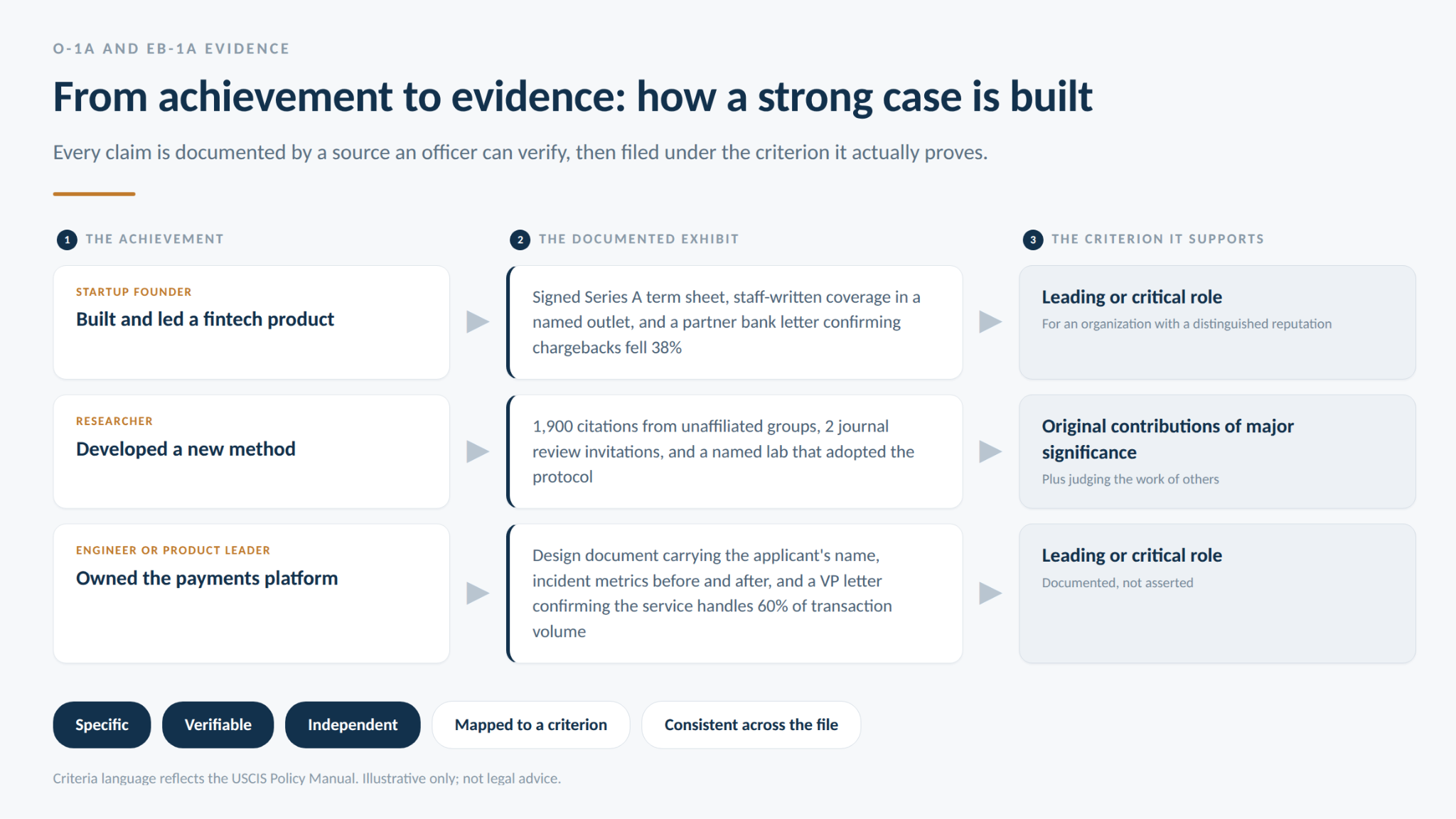
Evidence of impact over three hypothetical profiles:
Startup founder: “co-founded a fintech company” does not discuss impact, but “a $12 million Series A confirmed by the term sheet, staff-written national coverage, and a partner letter confirming your fraud model cut chargebacks by 38%” does;
Researcher: “published widely” does not demonstrate impact, but “41 papers, 1,900 citations from unaffiliated groups, two journal review invitations, and a named lab that adopted the protocol” does;
Engineer or product leader: “led the payments team” does not establish impact, but presenting the design document with the beneficiary’s name, before-and-after incident metrics, and a VP letter confirming that the service handles 60% of the transaction volume does.
Do not just describe the work or role; discuss the impact using evidence.
Consistency across documents
Officers read the file and analyse documents side-by-side, including your CV, expert letters, forms, publication list, awards, and LinkedIn or other public profiles, which should all agree on job titles, employers, and dates. A CV listing you as Head of Research in 2021 while a letter calls you a Senior Scientist invites doubt, even if it is technically correct. Checking these details early is much easier than fixing them right before filing (see PassRight’s article on Why Great Immigration Cases Are Managed, Not Just Filed).
What to Check Before Talking to an Immigration Lawyer
- Are your strongest claims proven by independent sources?
- Does every exhibit carry a date, a source, and a named author (specific details)?
- Is each exhibit clearly identified with the criterion it supports?
- Do several of your letters come from experts independent of your employer?
- Does each letter describe specific work and impact, rather than just speak on your character?
- Do your CV, forms, letters, and public profiles agree on titles and dates (consistent)?
- Does your recognition span several years, not one busy season (sustained acclaim)?
- Could an outsider explain why you qualify after 10 minutes with the file?
Answering “no” to several of these usually means that sufficient proof has yet to be gathered.
Make the decision easy to understand for USCIS
Remember that officers are not scoring your career. They are deciding whether the file before them supports an extraordinary ability visa. If an officer has to fill in the gaps or guess, the file is doing less work than it should be. Inconsistencies or under-developed cases can trigger a Request for Evidence (an RFE), which can cost time, effort, and money that could have been avoided with a strong filing from the outset. The challenge is often not the absence of achievements, but turning those achievements into a clear, well-documented record. An immigration attorney can help ensure that the record clears the bar.
FAQ
How many documents do I need for an O-1 or EB-1A case?
There is no set page requirement. USCIS weighs quality and warns that voluminous documentation may still lack persuasive evidence of eligibility. Petition length varies widely, and a disciplined filing regularly beats a padded one.Is meeting three criteria enough for approval?
No: meeting three criteria can clear the first step of the analysis only. USCIS then weighs the whole record to decide whether you show sustained national or international acclaim. Thin evidence can fail at the first step, and even a case that clears it can still fail at the second.What does independent recognition look like in an immigration case?
It looks like proof of your standing from someone other than you or your employer: awards judged by outside experts, editorially produced press, invitations to judge others’ work, citations from unaffiliated researchers, and adoption of your work by organizations you do not control.Are expert letters enough for proving “original contribution” for O-1 or EB-1A?
No. USCIS expects corroborating documents, metrics, and evidence across the field. The same logic applies to O-1: a letter works best when it explains one achievement in technical detail and points to underlying proof.What makes evidence weak even if the applicant is accomplished?
Usually one of four things: the achievement is real but undocumented, the proof comes from a source who is partial to the beneficiary, the record merely shows activity instead of measurable impact, or the exhibits are poorly tied to a particular criterion. Evidence that cannot be verified may fail to support the case and can leave important questions unanswered, potentially leading to an RFE.
Need help with your case? Schedule a call with our customer care team. They’ll be happy to discuss your needs and connect you with an immigration attorney.


